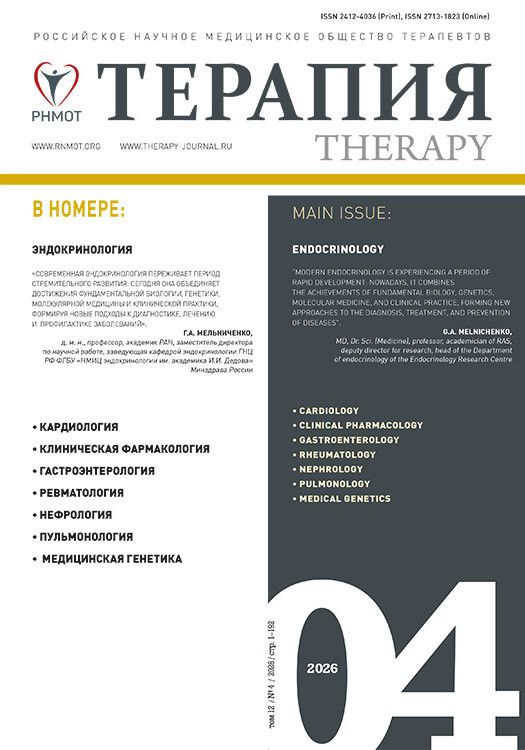
Amiodarone paradox: Hyperthyroxinemia without thyrotoxicosis – a management strategy analysis based on two clinical cases
Abstract. Amiodarone is an effective antiarrhythmic drug used for atrial fibrillation, but in some patients it develops euthyroid hyperthyroxinemia (EHT). EHT is a clinical and laboratory phenomenon characterized by elevated total and free thyroxine reverse triiodothyronine, and normal thyroid-stimulating hormone levels in the absence of symptoms of thyroid dysfunction. EHT does not require treatment, but if suspected, differential diagnosis is necessary to exclude more serious pathologies. In the presented clinical cases, EHT was detected precisely in patients receiving long-term amiodarone therapy. These observations illustrate the importance of a comprehensive approach, in which the decision to continue or discontinue amiodarone is based not on an isolated increase in free thyroxine levels, but on a thorough clinical assessment, dynamics of thyroid-stimulating hormone levels, and the absence/presence of hyperthyroidism symptoms. Maintaining amiodarone therapy in the presence of documented EHT and stable euthyroid status is a reasonable management strategy for these patients.A.N. Zvyagintseva, K.V. Melkozerov, I.Z. Bondarenko, O.A. Shatskaya, I.A. Khamnagadaev, V.Yu. Kalashnikov, N.M. Platonova, N.G. Mokrysheva
Keywords
euthyroid hyperthyroxinemia
atrial fibrillation
amiodarone
References
1. Клинические рекомендации. Амиодарон-индуцированная дисфункция щитовидной железы. Общероссийская общественная организация «Российское кардиологическое общество», Российская ассоциация эндокринологов, Ассоциации эндокринных хирургов. Рубрикатор клинических рекомендаций Минздрава России. 2024. ID: 805_1. Доступ: https://cr.minzdrav.gov.ru/view-cr/805_1 (дата обращения – 30.05.2026). (Clinical guidelines. Amiodarone-induced thyroid dysfunction. Russian Cardiology Society, Russian Association of Endocrinologists, Association of Endocrine Surgeons. Rubricator of clinical guidelines of the Ministry of Healthcare of Russia. 2024. ID: 805_1. URL: https://cr.minzdrav.gov.ru/view-cr/805_1 (date of access – 30.05.2026) (In Russ.)).
2. Свириденко Н.Ю., Платонова Н.М., Молашенко Н.В., Голицин С.П., Бакалов С.А., Сердюк С.Е. Эндокринные аспекты применения амиодарона в клинической практике (алгоритм наблюдения и лечения функциональных расстройств щитовидной железы). Российский кардиологический журнал. 2012;17(2):63–71. (Sviridenko NYu, Platonova NM, Molashenko NV, Golitsyn SP, Bakalov SA, Serdyuk SE. Endocrine aspects of amiodarone therapy in clinical practice (follow-up and treatment algorithm for patients with thyroid dysfunction). Rossiyskiy kardiologicheskiy zhurnal = Russian Journal of Cardiology. 2012;17(2):63–71 (In Russ.)). EDN: OWOEQJ.
3. Piva I, Barollo S, Censi S, Bertazza L, Ruggeri E, Clausi C et al. Euthyroid hyperthyroxinemia: relevance of albumin and transthyretin genetic variations in a single centre experience. Clin Chim Acta. 2025;574:120354.
PMID: 40349904. https://orcid.org/10.1016/j.cca.2025.120354
4. Medic F., Bakula M., Alfirevic M, Bakula M, Mucic K, Maric N. Amiodarone and thyroid dysfunction. Acta Clin Croat. 2022;61(2):327–41.
PMID: 36818930. PMCID: PMC9934045. https://orcid.org/10.20471/acc.2022.61.02.20
5. Krausova A. Amiodarone-induced thyreopaties. Cas Lek Cesk. 2025;164(3):94–99. PMID: 40818072.
6. (Anfinsen OG, Lima K. Amiodarone-induced thyrotoxicosis. Tidsskr Nor Laegeforen. 2021;141(16) (In English, Norwegian)).
PMID: 34758590. https://orcid.org/10.4045/tidsskr.21.0047
7. Трухина Д.А., Пржиялковская Е.Г., Белая Ж.Е., Григорьев А.Ю., Азизян В.Н., Мамедова Е.О. с соавт. Тиреотропин-секретирующие аденомы гипофиза: клинические особенности и результаты лечения 45 пациентов. Проблемы эндокринологии. 2024;70(2):23–36. (Trukhina DA, Przhiyalkovskaya EG, Belaya ZhE, Grigoriev AYu, Azizyan VN, Mamedova EO et al. Thyrotropin-secreting pituitary adenomas: Clinical features and results of treatment in 45 patients. Problemy endokrinologii = Problems of Endocrinology. 2024;70(2):23–36 (In Russ.)).
EDN: EPRHWA. https://orcid.org/10.14341/probl13325
8. Петрик Г.Г., Космачева Е.Д., Полякова Ю.И., Бутаева С.В., Рожинская Л.Я., Белая Ж.Е. Тиреотропинома: поздний диагноз и эффективность терапии. Проблемы эндокринологии. 2017;63(1):39–45. (Petrik GG, Kosmacheva ED, Polyakova UI, Butaeva SV, Rozhinskaya LYa, Belaya ZhE. TSH-secreting pituitary adenoma: Late diagnosis and effectiveness of therapy. Problemy endokrinologii = Problems of Endocrinology. 2017;63(1):39–45 (In Russ.)).
EDN: YMFPR. https://orcid.org/10.14341/probl201763130-36
9. Астафьева Л.И., Кадашев Б.А., Шишкина Л.В., Калинин П.Л., Кутин М.А., Сиднева Ю.Г., Шарипов О.И. Тиреотропиномы и тиреотрофная гиперплазия (описание клинических случаев и обзор литературы). Вопросы нейрохирургии им. Н.Н. Бурденко. 2016;80(3):82–90. (Astaf’eva LI, Kadashev BA, Shishkina LV, Kalinin PL, Kutin MA, Sidnevа YuG, Sharipov OI. Thyrotropin-producing adenomas and thyrotropic hyperplasia (clinical case reports and the review of the literature). Voprosy neyrokhirurgii im. N.N. Burdenko = Burdenko’s Journal of Neurosurgery. 2016;80(3):82–90 (In Russ.)).
EDN: WDOXBB. https://orcid.org/10.17116/neiro201680382-90
10. Khan AA, Ibrahim SI, Ata F, Wazwaz B, Hanoun MA, Belkhair S et al. Clinical characteristics and outcomes of patients with TSH-secreting pituitary adenoma and Graves’ disease – a case report and systematic review. Thyroid Res. 2024;17(1):3.
PMID: 38311752. PMCID: PMC10840192. https://orcid.org/10.1186/s13044-023-00184-2
11. Ускач Т.М., Аманатова В.А., Ардус Д.Ф., Сапельников О.В., Имаев Т.Э., Терещенко С.Н. Кардиология и кардиохирургия – симбиоз успеха лечения сердечной недостаточности. Терапевтический архив. 2025;97(9):762–772. (Uskach TM, Amanatova VA, Ardus DF, Sapelnikov OV, Imaev TE, Tereshchenko SN. Cardiology and cardiac surgery – a symbiosis of successful treatment of heart failure. Terapevticheskiy arkhiv = Therapeutic Archive. 2025;97(9):762–772 (In Russ.)).
EDN: JDBDNC. https://orcid.org/10.26442/00403660.2025.09.203375
About the Authors
Anastasia N. Zvyagintseva, MD, clinical resident of Endocrinology Research Centre, Moscow, Russian Federation.E-mail: zvyagintsevaanastasia@mail.ru
ORCID: https://orcid.org/0000-0003-1247-3481. Scopus ID: 59334011900. eLibrary SPIN: 2332-0601
Konstantin V. Melkozerov, MD, PhD (Medicine), cardiovascular surgeon of the Department of surgical treatment of complex cardiac rhythm disorders and cardiac pacing, Endocrinology Research Centre, Moscow, Russian Federation.
E-mail: melkozerovkv@gmail.com
ORCID: https://orcid.org/0000-0002-7328-6316. Scopus ID: 55376026700. eLibrary SPIN: 5307-9820
Irina Z. Bondarenko, MD, Dr. Sci. (Medicine), professor, head of the Department of cardiology, Endocrinology Research Centre, Moscow, Russian Federation.
E-mail: bondarenko.irina@endocrincentr.ru
ORCID: https://orcid.org/0000-0002-5178-6029. Scopus ID: 7102075259. eLibrary SPIN: 4524-4803
Olga A. Shatskaya, MD, PhD (Medicine), leading researcher at the Department of cardiology, Endocrinology Research Centre, Moscow, Russian Federation.
E-mail: shackaya.olga@endocrincentr.ru
ORCID: https://orcid.org/0000-0003-1831-8052. Scopus ID: 36842258700. eLibrary SPIN: 3778-0968
Igor A. Khamnagadaev, MD, Dr. Sci. (Medicine), head of the Department of surgical treatment of complex cardiac rhythm disorders and cardiac pacing, cardiovascular surgeon, associate professor of the Department of personalized and translational medicine, Endocrinology Research Centre; senior researcher at the Department of pediatric cardiology and arrhythmology of Yu.E. Veltischev Institute of Pediatrics, Pirogov Russian National Research Medical University, Moscow, Russian Federation.
E-mail: hamnagadaev.igor@endocrincentr.ru
ORCID: https://orcid.org/0000-0002-9247-4523. Scopus ID: 57201129395. eLibrary SPIN: 6338-4990
Viktor Yu. Kalashnikov, MD, Dr. Sci. (Medicine), professor, corresponding member of RAS, head of the Department of cardiology, endovascular, and cardiovascular surgery, Endocrinology Research Centre, Moscow, Russian Federation.
E-mail: kalashnikov.victor@endocrincentr.ru
ORCID: https://orcid.org/0000-0001-5573-0754. Scopus ID: 55554092100. eLibrary SPIN: 5342-7253
Nadezhda M. Platonova, MD, Dr. Sci. (Medicine), head of the Department of therapeutic endocrinology, Endocrinology Research Centre, Moscow, Russian Federation.
E-mail: doc-platonova@inbox.ru;
ORCID: http://orcid.org/0000-0001-6388-1544. Scopus ID: 9537089700. eLibrary SPIN: 4053-3033
Natalya G. Mokrysheva, MD, Dr. Sci. (Medicine), professor, academician of RAS, head of the Department of personalized and translational medicine, director of Endocrinology Research Centre, Moscow, Russian Federation.
E-mail: mokrisheva.natalia@endocrincentr.ru
ORCID: https://orcid.org/0000-0002-9717-9742. Scopus ID: 35269746000. eLibrary SPIN: 5624-3875
Similar Articles